

Logistics runs on margins that would make most industries nervous. Freight broker margins dropped to 10-13% in mid-2025, and owner-operator profitability hit its lowest point since 2010 according to the CSCMP State of Logistics Report. The marginal cost of trucking reached $2.27 per mile in 2023, and it hasn’t come down much since.
When your margins are that thin, the difference between a profitable quarter and a losing one usually isn’t about winning new contracts or raising rates. It’s about what’s leaking out of your operation that you can’t see. And for most logistics companies, the leaks are in three places: fuel waste they can’t measure at the truck level, breakdowns they didn’t see coming, and driver behavior patterns nobody has time to address.
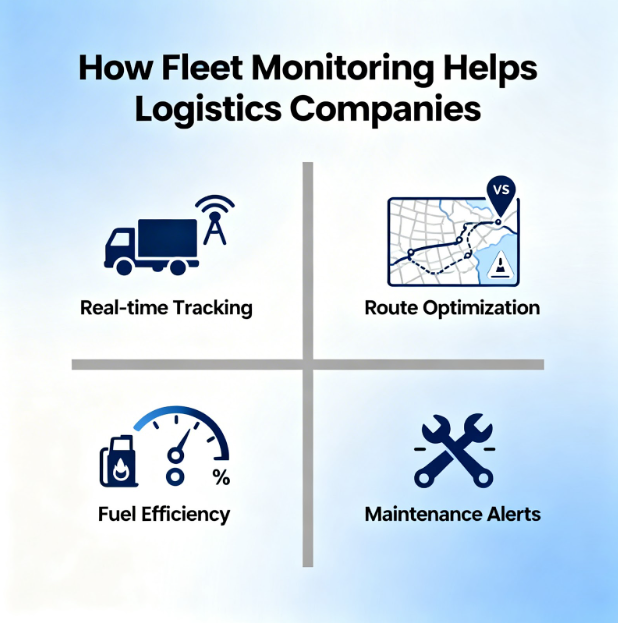
Fleet monitoring closes those gaps. Not the old version of fleet monitoring, which was basically a GPS map and a phone call to dispatch. The current version, which connects engine data, driver behavior, fuel consumption, maintenance signals, and route performance into a single operational picture.
The fuel problem is bigger than most logistics companies admit
Fuel represents somewhere between 24% and 50% of total fleet operating costs, depending on who you ask and what they include in the calculation. The ATRI puts fuel at roughly a quarter of per-mile costs for truckload carriers. Other analyses, especially for long-haul operators, put it closer to 40%. Either way, it’s the largest variable cost in the operation and the one most logistics companies have the least visibility into.
Most carriers track fuel at the fleet level. Total gallons purchased, total dollars spent, maybe a rough cost-per-mile figure. That’s like a restaurant tracking food costs without knowing which dishes are profitable and which ones are losing money on every plate.
Truck-level fuel monitoring changes the math. When you can see that Truck #31 is burning 14% more fuel than Truck #32 on the same lane with similar loads, you can actually investigate why. Maybe #31 has an injector issue nobody’s caught. Maybe the driver idles for 45 minutes at every pickup while the other driver shuts down. Maybe the route assignment puts #31 through a construction zone that adds 20 minutes of stop-and-go.
One 185-vehicle regional carrier implemented truck-level fuel intelligence and cut fuel costs by 18% in the first year. That translated to $847,000 in annual savings. They didn’t replace their trucks or change their routes dramatically. They made the waste visible, and then they addressed it.
The part that surprises most logistics operators: visibility alone drove about 40% of the improvement before any incentive programs launched. Once drivers and managers could see actual per-truck performance data, behavior shifted. People don’t leave the kitchen light on when the electric bill shows which room is using the most power.
Breakdowns don’t just cost the repair, they cost the customer
A delivery truck breaking down on the highway is an annoyance for most industries. For a logistics company, it’s a cascade failure. The load is late. The customer’s production schedule or retail restock is disrupted. A backup truck has to be dispatched, often at premium cost. The driver’s hours are blown. The next load on that truck’s schedule gets pushed or reassigned. And if it happens to the same customer twice, you’re in a rebid conversation.
The industry average for unplanned downtime is 25 hours per month per facility, according to Machine Metrics data. For a logistics company running 50+ trucks, even a handful of roadside breakdowns per month can shred on-time delivery metrics and customer relationships.
Predictive monitoring addresses this by tracking component behavior against each vehicle’s baseline. A cooling system running slightly hotter than normal. Fuel burn patterns shifting in ways that suggest injector wear. Battery voltage dropping incrementally over weeks. None of these trigger a warning light. All of them, if ignored, eventually strand a truck and a driver somewhere inconvenient.
The predictive analytics approach that works best for logistics fleets is condition-based: monitor how each truck actually behaves, compare it to its own healthy baseline, and flag deviations early enough to schedule shop time during planned downtime instead of losing a truck mid-route. The data consistently shows 30-50% reduction in unplanned downtime and 20-25% lower maintenance costs when this approach is implemented. For a logistics company where every truck-hour matters, that’s not a nice-to-have. That’s the difference between making money and not.
Driver behavior is a cost problem disguised as a safety problem
Most logistics companies think of driver monitoring as a safety tool. And it is. But the financial impact of driving behavior is usually larger than the safety impact, especially for fleets that haven’t experienced a major accident recently and therefore don’t feel the urgency.
The U.S. Department of Energy reports that aggressive driving, hard acceleration, harsh braking, and speeding, can reduce fuel economy by 15-30%. On a truck burning 20,000 gallons a year, even a 15% efficiency penalty from aggressive driving patterns is 3,000 gallons of wasted fuel. At $3.50 per gallon, that’s $10,500 per truck. Across 50 trucks, it’s over half a million dollars.
Fleet monitoring platforms that score driving behavior and connect those scores to specific cost and safety outcomes change the conversation with drivers. It’s not “drive better because we said so.” It’s “this specific habit costs us $180 per month on your truck, and here’s the data.” That second conversation is one drivers actually respond to, especially when there’s a coaching program or incentive structure attached.
The insurance angle reinforces this. Insurers are now offering up to 20% premium reductions for fleets with telematics-verified safety programs. Fleets that combine driver behavior monitoring with dash cam footage are seeing claims frequency drop by 22% and accident severity decline by 25%. For a logistics company spending $300,000 a year on insurance, a 20% reduction pays for the monitoring platform several times over.
Why logistics companies specifically benefit more than other industries
A construction company with 30 trucks uses fleet monitoring to reduce costs and that’s valuable. But a logistics company with 30 trucks uses the same monitoring to protect its core product, which is reliable transportation.
When a construction truck breaks down, the job site waits. When a logistics truck breaks down, the customer’s supply chain breaks. That’s a different level of consequence. Logistics companies compete on reliability and price, and fleet monitoring directly affects both.
The other factor is asset utilization. Logistics trucks need to be moving, loaded, generating revenue. Every hour a truck sits in a shop for an unplanned repair is an hour it’s not earning. Every extra gallon of fuel burned to idling or aggressive driving is margin that disappeared. Every preventable accident is an insurance premium increase that hits every truck in the fleet.
For logistics operators in high-growth markets, especially in countries like India where fleet sizes are scaling rapidly and infrastructure creates unpredictable operating conditions, AI-driven fleet monitoring becomes even more important. Larger fleets operating on inconsistent roads with variable fuel quality and driver skill levels amplify every inefficiency. The same monitoring principles apply, but the savings multiply.
What a logistics company should actually look for
If you’re evaluating fleet monitoring for a logistics operation, the features that matter most are the ones that connect directly to revenue and cost:
Per-truck fuel consumption tied to specific routes and drivers, not fleet averages. The ability to identify which trucks are costing you more than they should and why.
Condition-based maintenance alerts that flag problems before they trigger fault codes. The window between “data shows a drift” and “truck throws a code” is typically three to six weeks. That window is where all the value lives.
Driver behavior scoring that ties to dollar figures, not just grades. A driver with a “C” safety score doesn’t mean anything until you can show that the “C” behavior costs $900 more per month than a “B” behavior pattern.
Integration with your dispatch and scheduling systems, so maintenance forecasts and truck availability data feed directly into load planning. If your monitoring platform and your dispatch system don’t talk to each other, you’re still making decisions on incomplete information.
The logistics companies that figure this out don’t just save money. They deliver more reliably, which is the only sustainable competitive advantage in a business where anyone can buy a truck and get a broker license. The hard part was never moving freight. It’s moving it consistently, on time, without surprises, and still making money at the end of the month. Monitoring doesn’t solve every operational headache. But it solves the ones that bleed the most.